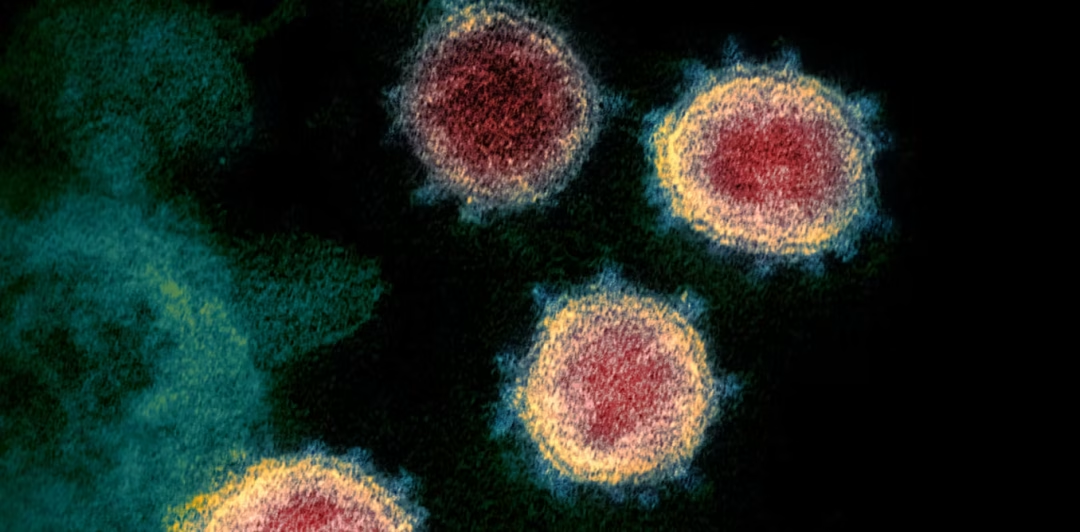
Viruses are obligate intracellular pathogens. In order to replicate, they need to gain access to host cells.
Hallmarks of the viral life cycle including extracellular and intracellular elements. Virions bind extracellular structures on their target, before their genome enters and host cell processes are hijacked in favor of viral replication and assembly. In response to a viral infection, not only must infected cells be dealt with, but infection of further cells must be prevented. As such, cell-mediated and antibody responses are both required to eliminate viral infection.
Intracellular pathogen recognition receptors in host cells, such as toll-like receptors, recognize structures inherent to a viral pathogen, including double-stranded RNA genomes and uncapped RNA. The resulting signaling events would result in the activation of transcription factors, and downstream gene expression and secretion of Type I interferons. These type I interferons would then act upon receptors on other cells, effectively telling these cells to shut-down protein synthesis. This antiviral state would ensure that if viruses were to infect other cells, they would be unable to replicate, as the protein synthesis mechanisms they are dependent upon would be inactive.
For complete elimination of infection, an adaptive response is still required.
Antibodies can be produced and secreted by B cells, neutralizing virus particles and thereby limiting infection of host cells.
A cell-mediated response also sets in motion.
Upon viral infection of host cells, viral proteins are synthesized, some of which are broken down into peptides and loaded onto MHC class 1 proteins for presentation.
Dendritic cells, meanwhile, can phagocytose virus particles and upon the breaking down of virus proteins, can present viral-derived peptides on MHC class 2 proteins.
Dendritic cells play a foundational role in initiating the adaptive immune response, presenting an MHC-peptide complex that is recognized by a specific T cell and its T cell receptor.
To deal with virally-infected cells, a CD8 T cell response is required. As discussed prior, one of the signals crucial to CD8 T cell activation is the presentation of pathogen-derived antigen on an MHC class 1 protein.
At first glance, this looks like a real problem. Viruses can be phagocytosed by a dendritic cell (and peptides can thus be presented by the dendritic cell on MHC class 2 proteins), but they do not readily infect dendritic cells (meaning the pathway that results in peptide presentation on MHC class 1 proteins does not always occur).
Thankfully, dendritic cells have a unique ability to cross-present! That is, the virus particles that they take in via phagocytosis can be presented on either of MHC class 1 or class 2 proteins. This means that the dendritic cell has the ability to activate both CD4 and CD8 T cells, ensuring that even if a dendritic cell is not infected, a robust T cell response can still develop.
During the activation of CD4 T cells, the dendritic cell releases IL-12, which directs the CD4 T cell to produce the cytokines IL-2 and IFN-g. These cytokines act upon CD8 T cells which are being activated in the vicinity, which do not produce a sufficient amount of the cytokine to proliferate and develop on their own.
Ready and equipped to kill target cells that are presenting viral peptides on MHC class 1 proteins, CD8 T cells go on to leave the lymph node and search. Once its receptor finds and recognizes MHC class 1 proteins presenting viral peptide, it binds and initiates a signal event.
From the moment of cell to cell contact, the proteins perforin and granzyme are synthesized and secreted. Holes are punched in the infected cell’s membrane. Granzymes enter, and initiate apoptosis via their enzymatic activity. The infected cell is killed, and the CD8 T cell releases itself, ready to find other infected cells.
This article’s content was created based upon the background accrued over the course of the author’s Honours BSc Degree in Microbiology & Immunology, which included Immunology, Virology, and Bacterial Pathogenesis course-work and exposure to topics from Janeway’s Immunobiology.
