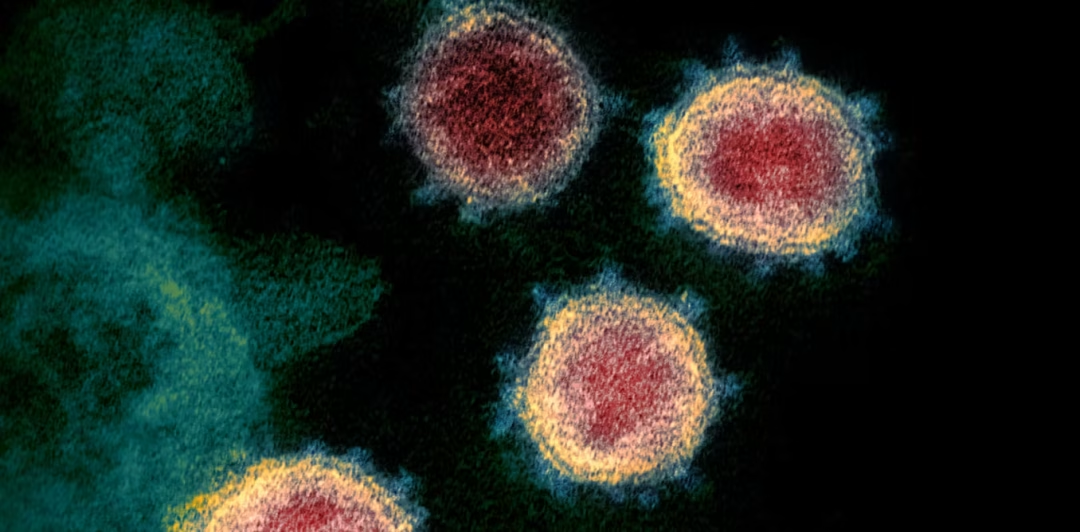
Viruses are obligate intracellular pathogens. In order to replicate, they need to gain access to host cells. Hallmarks of the viral life cycle including extracellular and intracellular elements. Virions bind extracellular structures on their target, before their genome enters and host cell processes are hijacked in favor of viral replication and assembly. In response to … Continue reading IMMUNOLOGY 101 – Fighting Viral Infections

IMMUNOLOGY 101 – Fighting Intracellular Bacterial Infections
Some bacteria like Mycobacterium tuberculosis, the causative agent of tuberculosis, are intracellular pathogens. They invade and reside inside host cells, including those of the immune system, such as macrophages. Inside the macrophage, the typical bacterial killing strategy does not go according to plan when dealing with intracellular bacteria. Some can aptly withstand the acidity. Some … Continue reading IMMUNOLOGY 101 – Fighting Intracellular Bacterial Infections

IMMUNOLOGY 101 – Fighting Extracellular Bacterial Infections
Some infections don’t develop within our cells - many are extracellular. Once these pathogens have gotten past the first line of defense, our skin, resident mast cells and macrophages jump into action. Histamine is released and blood flow to the site of infection is increased. PAMPs are recognized, driving the phagocytosis of the invading pathogen … Continue reading IMMUNOLOGY 101 – Fighting Extracellular Bacterial Infections

IMMUNOLOGY 101 – B-cell Activation
B cells circulate throughout our blood, lymph, and secondary lymphoid organs. Sometimes, in the lymph nodes and spleen, soluble components from a pathogen appear. B cells, expressing a molecule called a B cell receptor at its surface, can bind those components (called antigens) directly. Cross-linking occurs, wherein many nearby B cell receptors recognize components of … Continue reading IMMUNOLOGY 101 – B-cell Activation

IMMUNOLOGY 101 – T-cell Activation
The innate response is typically enough to resolve the vast majority of infections. For the minority of cases for which it doesn’t quite suffice, the adaptive response enters the picture. This is where we have B cells generating antibodies, and T cells making cytokines and killing infected cells. Also at the site of infection are … Continue reading IMMUNOLOGY 101 – T-cell Activation

IMMUNOLOGY 101 – The Innate Immune Response
The innate immune response is tasked with responding immediately to an invading pathogen and getting rid of it before disease develops. You may wonder - how does the innate response recognize something as being an invading pathogen? How does it see the danger? How does it know something is foreign? The cells of our innate … Continue reading IMMUNOLOGY 101 – The Innate Immune Response

IMMUNOLOGY 101 – An Overview of the Immune System
Our earth is home to trillions of microorganisms. On a daily basis, we are exposed to countless viruses, bacteria, fungi, and parasites, and yet, while many of these microscopic organisms are disease-causing, we aren’t perpetually bed-ridden and calling in sick from work. We have our body’s defense system to thank for that. The What! In … Continue reading IMMUNOLOGY 101 – An Overview of the Immune System